
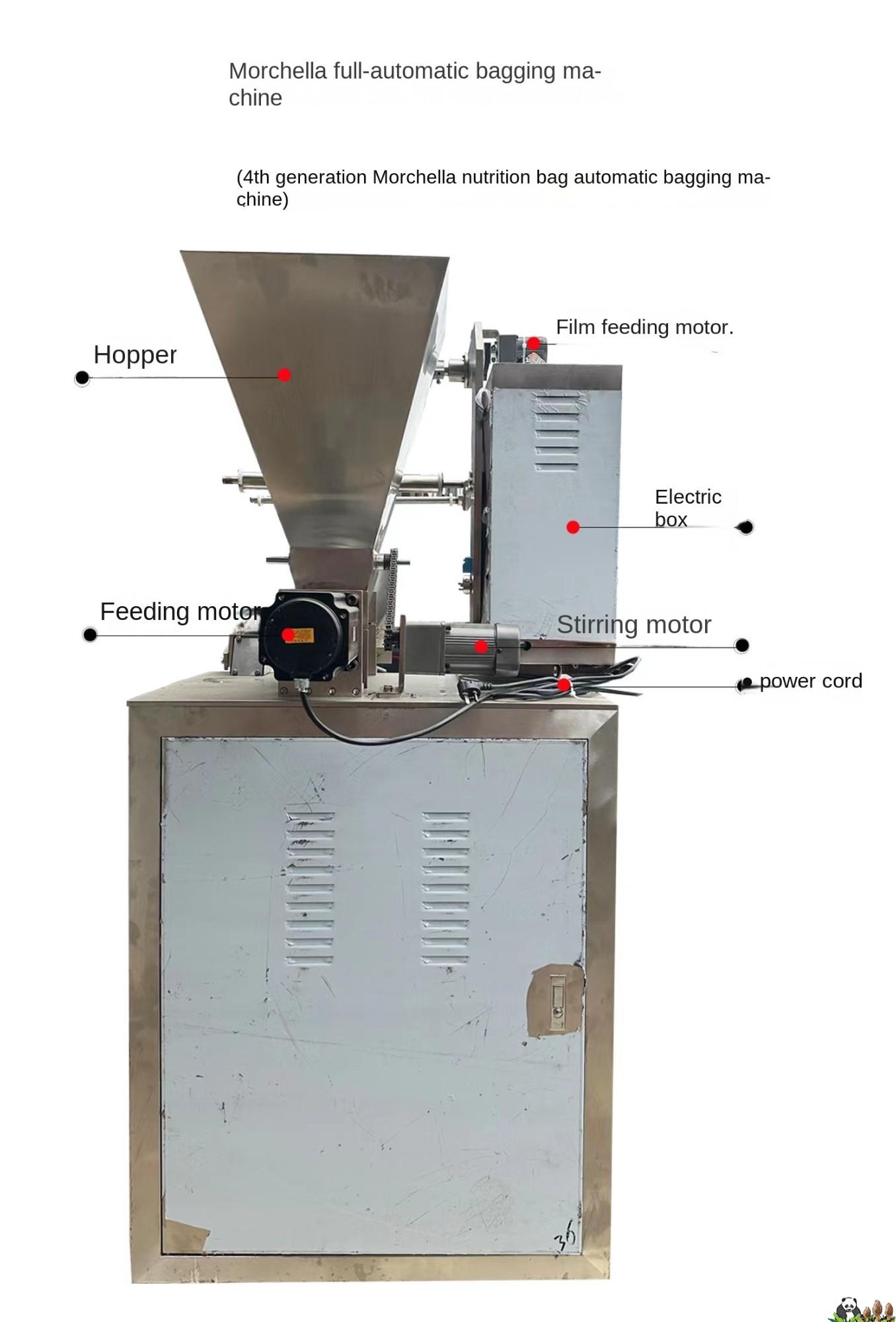
Morchella Full-Automatic Bagging Machine (4th Generation ENB Nutrition Bag Machine)
The 4th generation Morchella nutrition bag automatic bagging machine adopts stirring spiral blanking to ensure clean and smooth material discharge. Compatible with fermented substrates including corncob, grain husk, sawdust, and soaked wheat. Highly efficient operation allows one machine to support the workload of 15–25 workers. Easy to operate and built for continuous industrial duty, it is an essential core equipment for large-scale factory production of Morchella nutrition bags.
Technical Specifications
| Model / Generation | 4th Generation Morchella Nutrition Bag Automatic Machine |
|---|---|
| Packing Speed | 30 - 50 bags / min (1,800 - 3,000 bags / hr) |
| Bag-Making Width | 260 - 420 mm (customizable according to requirements) |
| Bag-Making Length | 200 - 300 mm (adjustable according to needs) |
| Packing Weight | 300g - 1,000g (adjustable according to needs) |
| Power Supply | 220V / 50Hz / 1.5 kW |
| Machine Weight | Approx. 380 kg |
| Overall Dimensions | 80 cm (L) × 120 cm (W) × 170 cm (H) |
| Packaging Film Width | 280mm, 320mm, 360mm, 420mm |
| Packaging Film Material | High-quality, high-temperature resistant PP composite film (with micro-vent holes) |
| Rolling Film Thickness | Approx. 4.5 - 5.5 Silk (0.045 - 0.055 mm) |
Available Configurations
Available ConfigurationsProduct Video Demonstration
ENB Automatic Bagging Machine Real-World Operation Video
Video Overview: Watch the ENB automatic nutrient bagging machine in real-world operation: high-speed substrate feeding, automatic bag mouth sealing, and high-efficiency Morel farm production.
Frequently Asked Questions
What raw substrate materials can the 4th Generation ENB Automatic Bagging Machine process?▾
Equipped with a heavy-duty stirring spiral auger mechanism, the machine smoothly processes fermented substrates including corncob granules, grain husk, sawdust, rice bran, and soaked wheat without clogging. Substrate moisture should be maintained at 60%–65% field capacity for optimal blanking.
How does the machine prevent nutrition bags from expanding or bursting during high-temp sterilization?▾
The machine features an integrated micro-hole ventilation puncher. As the polypropylene (PP) film is rolled into bags, micro-vent holes are punched automatically. During high-pressure autoclave sterilization (121°C–126°C), steam pressure balances through the micro-vents, eliminating air trapping and bag explosion.
What is the packing speed and how many manual workers can one machine replace?▾
Operating speed ranges from 30 to 50 bags/min (1,800 to 3,000 bags/hr, depending on package weight). A single ENB automatic machine efficiently replaces 15 to 25 manual workers while maintaining uniform bag compaction density and sealing.
Can bag dimensions (length & width) and packaging weight be customized?▾
Yes. Bag-making width (260mm to 420mm) can be customized via forming molds. Bag length (200mm to 300mm) and packing weight (300g to 1,000g) are easily adjustable on the machine control panel.
What rolling film thickness and material specifications are recommended?▾
We recommend high-quality, high-temperature resistant polypropylene (PP) composite film with a thickness of 4.5 to 5.5 Silk (0.045–0.055 mm). Supported rolling film widths are 280mm, 320mm, 360mm, and 420mm.
What are the power supply and space requirements for machine installation?▾
The machine operates on a single-phase 220V / 50Hz power supply with a low power rating of 1.5 kW. It features a compact dimension of 80cm (L) × 120cm (W) × 170cm (H) and weighs approx. 380 kg, making it easy to install in standard farm workshops or container cabins.
How are Exogenous Nutrition Bags (ENB) applied in the field during Morel cultivation?▾
After high-temperature autoclave sterilization (121°C) and cooling, ENB bags are inoculated with spawn. Once mycelium colonizes the field bed (7–14 days post-sowing), the nutrition bags are slit on one side and placed face-down on the soil bed to supply essential nutrients directly to the mycelium before fruiting.